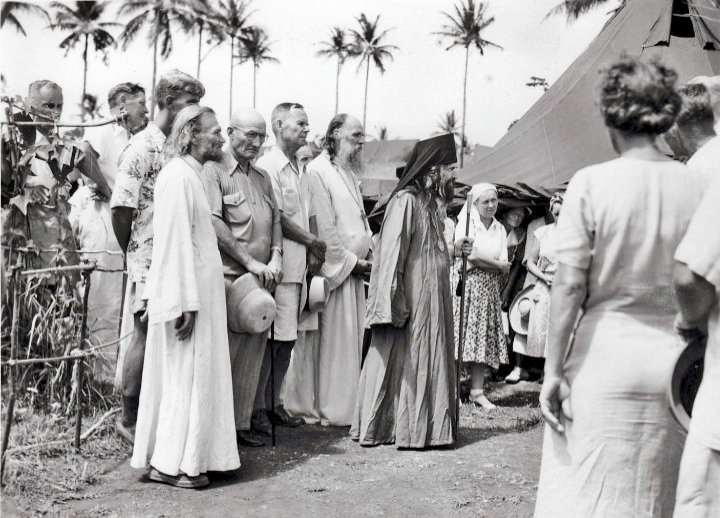
Russians in the Jungles of Tubabao
(Based on material by S. Fitzpatrick, with additions)
1. Introduction: Fleeing a New “Red Menace”
In late 1948 and early 1949, a mortal danger loomed over the vast community of “White émigrés” in China. Shanghai, Tianjin, and Harbin—which had become home to hundreds of thousands of Russians who had fled the Bolshevik regime following the 1917 Revolution and the Civil War—were rapidly falling under the control of Mao Zedong’s Chinese Communists. The term “White émigrés” encompassed ethnic Russians, Cossacks, Ukrainians, Armenians, and Russian Jews; for them, the arrival of the Communists meant inevitable forced repatriation to the USSR and death in the GULAG camps.
Recognizing the catastrophic nature of the situation, the International Refugee Organization (IRO)—an agency of the United Nations—began a frantic search for a temporary refuge, prompted by pressure from the Russian Émigré Association (REA). However, every country approached rejected the request. The only leader to show compassion was the President of the Philippines, Elpidio Quirino. He agreed to accept up to 6,000 Russian refugees for a period of four months, anticipating that the IRO would find them permanent places for resettlement during that time. The sparsely populated island of Tubabao, in the province of Samar, was designated as the site for their temporary stay.
A legendary story, which captures the intense atmosphere of those days, is associated with this evacuation. Initially, the IRO (International Refugee Organization) planned to evacuate only the 500 most prominent leaders of anti-communist organizations from Shanghai—those whose lives were in immediate danger. Upon learning this, Colonel Grigory Bologov, chairman of the Russian Emigrant Association (REA), drew his pistol right there in the IRO office and declared that he would take his own life unless every Russian who wished to leave was included on the evacuation lists. The IRO relented, increasing the quotas and granting the REA the authority to handle the selection process. As a result, approximately 5,000 people were chosen for evacuation.
2. Taming the Jungle: The First Days in a Hellish Paradise
The evacuation began in January 1949. The first ship departed Shanghai with 500 refugees on board and arrived at Tubabao in the midst of the tropical rainy season. The advance party was confronted with a grim reality: there was no infrastructure on the island—only scrub brush and palm trees. Colonel Konstantin Kluge, the leader of this first group, was so appalled by what he saw that he refused to allow the women and children to disembark into the torrential downpour. His defiant act—which included insulting a representative of the Philippine president, a Mr. Eugenio—led to his arrest. In response, Bologov flew out from Shanghai immediately to take personal command of the camp.
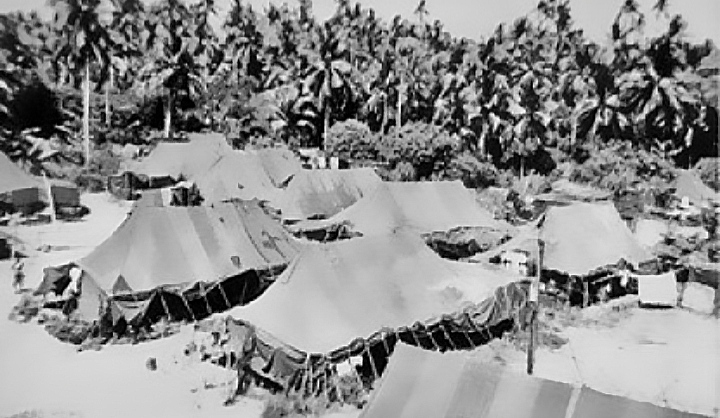
The island of Tubabao was teeming with mosquitoes, scorpions, and venomous snakes. The exhausted refugees’ first shelter consisted of army tents, which were frequently torn away by the wind. Every morning began with an essential ritual: shaking out one’s shoes and clothing, as venomous scorpions and centipedes often hid inside. Water for drinking and daily use was drawn from a local river and boiled in buckets and kettles over open fires.
Despite the grueling conditions, the Russians displayed remarkable resilience. Men of all ages went out daily to clear the jungle with machetes, hacking through the undergrowth and draining swamps. Women worked in communal kitchens, preparing food in massive cauldrons. Within a few months, a “Russian town” had sprung up on the uninhabited island. The refugees installed a wooden water-supply system and roads, and built a tent hospital, a dental clinic, a school, and even an open-air cinema where American films were screened. During a visit to the camp, President Quirino was so impressed by the culture of the Russians that he ordered the removal of the barbed wire surrounding the site, emphasizing that these people were free guests of the republic, not prisoners.
3. A Spiritual Shield: Saint John of Shanghai
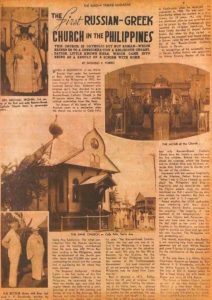
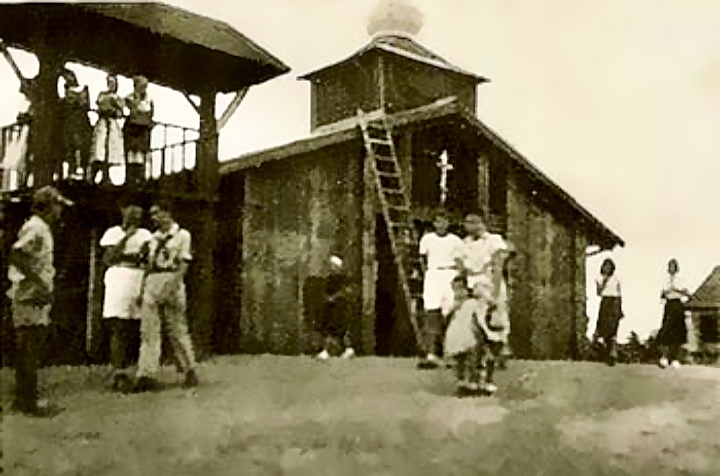
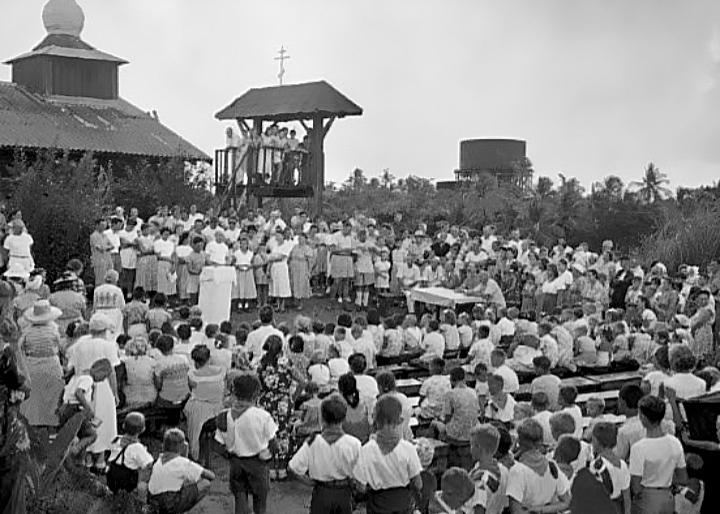
The Orthodox faith served as the moral and spiritual foundation of the camp. An abandoned American military barracks was converted into the Cathedral of the Holy Theotokos, which became the heart of Tubabao. Archbishop John (Maximovitch)—who had arrived from Shanghai and was later canonized as a great saint—played a pivotal role in the life of the camp. Despite the tropical heat, Vladyka John conducted daily divine services, established an orphanage on the island, and visited the critically ill in the hospital. Every night, the hierarch would walk around the entire camp from all four sides, blessing the island with the sign of the cross and praying for the people to be spared from the fury of nature. During the two years the Russian archpastor spent on Tubabao, not a single storm caused any serious damage to the camp.
4. The Flip Side of a Tropical Paradise: Political Rifts, Disease, and “Mallorca”
As time passed—with the promised four months stretching into two long, agonizing years of waiting—the “tedium of life” and the prevailing uncertainty began to erode the moral fabric of the community. For the children and teenagers, Tubabao felt like an exciting, Jules Verne-esque adventure; they were active in the scouting movement, wore orange neckerchiefs, and held costume balls in the camp’s central “Red Square.” For the adult population, however, life had become a grueling ordeal.
Internal political strife intensified within the camp. Cossacks and monarchists found themselves at odds with representatives of the anti-Soviet organization, the National Alliance of Russian Solidarists (NTS).
Health issues became a major concern. An examination conducted by Dr. Han Li-min, a Chinese physician working for the IRO (International Refugee Organization), revealed that nearly 10% of the camp’s population had tuberculosis. The prevailing sense of despondency was exacerbated by “Mallorca”—a cheap, locally produced brandy sold by Filipino merchants. The easy availability of alcohol triggered an outbreak of alcoholism and mental health disorders. Some young Russian women, despairing of ever receiving visas, turned to prostitution, finding clients among the soldiers of the Filipino army stationed nearby. Bologov himself waged a relentless battle against the official IRO administration—represented by Captain Coombs—by flooding international authorities with complaints.
5. Diverging Paths: Australia’s Rigorous Selection Process vs. the American Dream
Initially, the refugees perceived Australia as a distant, sweltering, and wild land inhabited solely by kangaroos. Almost everyone on Tubabao dreamed of reaching America. The United States, however, kept its doors firmly shut, while Australia—driven by pragmatic considerations—began an official intake process.
In March 1949, an Australian selection commission arrived on Tubabao. Canberra’s criteria were both pragmatic and stringent:
1. Age and family status: Preference was given to single men under the age of 45–50, single women under 35, and childless couples—all of whom had to be capable of performing manual labor.
2. Racial restrictions: The requirement that applicants be of “European race” was strictly enforced. This led to major legal complications regarding a group of 48 mixed-race orphans—children born from unions with Chinese individuals—whom Archbishop John had brought from Shanghai. Australia refused to admit them, but in the end, the Archbishop managed to take them with him to New York.
3. Mandatory labor: Migrants were required to perform strenuous work in mines, logging operations, or construction projects for a period of two years. This deterred many from choosing to relocate to the country.
4. Australian medical authorities were fanatically vigilant; any suspicion of tuberculosis resulted in the rejection of both the applicant and their entire family. Political vetting also hit a snag: about half of the refugees had previously held Soviet passports—obtained in Harbin as a survival tactic—and many had collaborated with the Japanese occupiers. Ultimately, however, Canberra reached a compromise, agreeing to assess an individual’s loyalty based solely on their conduct while at the Tubabao camp. Throughout 1949, three ships transported 1,372 people to Australia.
6. A Breakthrough in the U.S.: Archbishop John’s Diplomatic Victory
For the 3,500 refugees remaining on the island, the United States offered the only hope for salvation. In 1949, Archbishop John of Shanghai flew to Washington. Commanding great respect, he effectively “laid siege” to the U.S. Senate and Congress. He met with prominent American politicians, spent weeks lobbying on behalf of the Russian émigrés, and prayed for hours on the steps of the Capitol. He received tremendous support from Alexandra Tolstoy (the youngest daughter of the writer Leo Tolstoy), who headed the Tolstoy Foundation in the United States. In April 1950, the U.S. Congress allocated a quota of 4,000 visas for refugees from China. In September 1950, an American immigration mission arrived on Tubabao. Unlike the Australian program, the American one proved far more humane: they accepted people in entire family units—keeping the elderly and children together—and also welcomed those who had recovered from tuberculosis.
Throughout 1950 and 1951, the United States took in approximately 3,000 refugees from Tubabao. The island emptied rapidly. San Francisco became the new capital of the Russian Far Eastern diaspora. Grigory Bologov also relocated to California, where he became the head of the All-Cossack Union. Archbishop John later took charge of the Western American Diocese of the Russian Orthodox Church Outside of Russia (ROCOR), spending the remainder of his life in San Francisco, where his miracles gained worldwide renown.
7. Typhoon “Amy” and the End of the Pacific Odyssey
On December 9, 1951—at a time when only a few hundred “difficult” cases remained on the island (individuals with disabilities, the seriously ill, the elderly, and those suffering from severe mental health conditions)—Super Typhoon “Amy” struck the region. Fierce winds and massive waves destroyed most of the structures overnight. Two Russian refugees perished. Archbishop John’s protective “shield of prayer” was no longer present on the island; he had already departed the Philippines.
The camp ceased to exist. The remaining people had to be urgently evacuated to Manila. At the end of 1951, the IRO (International Refugee Organization) mandate expired, and the World Council of Churches took over the task of managing their future.
8. The Historical Legacy of the “Tubabaoans”
In total, about 1,500 people found a new home in Australia, and more than 3,000 people settled in the United States.
Despite the initial, stringent barriers imposed by the Australian authorities, the Russian community in Sydney managed to bring over their elderly parents who had remained in the Philippines.
In the memory of the Russian diaspora, the Tubabao camp took on a romanticized aura. For decades, the former refugees—who proudly refer to themselves as “Tubabaoans”—would gather for commemorative anniversaries in Sydney, San Francisco, and Los Angeles. In 2016, the Congress of Russian Americans organized a major exhibition titled “Tiempo Ruso” dedicated to the memory of Saint John of Shanghai, Colonel Grigory Bologov, and President Elpidio Quirino. On the island of Tubabao itself, the Philippine government has installed a memorial marker honoring the humanitarian spirit of the Filipino people, while the Russian Orthodox Church has erected a commemorative cross. The Philippine-Vietnamese Diocese of the Russian Orthodox Church plans to build a small church in the center of the island.